
Articles
The History of Prayer Beads Across Civilizations: Tracing the Cultural Roots of Meditation Beads
This reference article traces the historical roots of the "Misbaha" (prayer beads) as a cross-cultural human tool. From the frescoes of ancient civilizations, through the Asian "Mala" and the Christian Rosary, to the precise geometric design of the Islamic Misbaha and the Greek Komboloi. We explore how this simple string of beads evolved from a ritual counting device into a masterpiece of craftsma
Introduction: More Than Mere Adornment
The Misbaha (or prayer beads) has never been merely an ornamental accessory; it is one of the oldest tools invented by humanity for meditation and spiritual discipline. Intriguingly, in historical linguistics, the English word "bead" is derived from the Old English word "bede," which translates to "prayer"—tangible linguistic evidence that the spiritual function of beads preceded their aesthetic use.
The Earliest Archaeological Evidence
Archaeological evidence suggests that the concept of stringing beads has deep historical roots. Researchers posit that the oldest known visual representation of a string of beads used in a ritualistic context appears in the "Adorants" fresco in the Akrotiri settlement on the Greek island of Santorini, dating back to the 17th century BC (c. 1600 BC).
Eastern Traditions: The Meditation "Mala"
The Hindu tradition is among the oldest systems to codify the use of beads, known as the "Japa Mala." A traditional Mala consists of precisely 108 beads, often crafted from natural materials like "Rudraksha" seeds. This tradition later transitioned into Buddhism, where monks utilized these beads to regulate breathing and recite Sutras.
Christianity: The Holy Rosary
In Christian heritage, prayer beads became known as the "Rosary," derived from the Latin "Rosarium," meaning "rose garden." The institutionalization of its use is largely attributed to the Dominican Order in the 13th century.
The Islamic System: The Geometry of the Misbaha
In the Islamic world, the Misbaha underwent precise geometric and functional evolution. Historical sources indicate the widespread use of counting beads among Muslims by the 8th and 9th centuries AD.
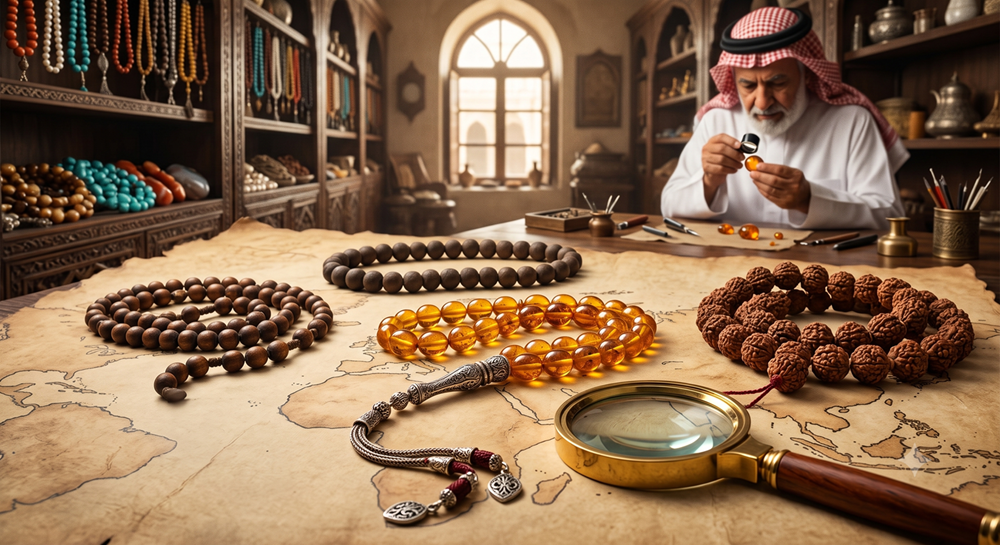
The Islamic Misbaha features a mathematical design, typically consisting of 99 beads, or 33 beads cycled three times. This necklace is punctuated by structural elements that are now the focal point of modern collectors and artisans: the "Imam" (the leading bead), the separators, and the "Tassel." This functional abstraction allowed for an immense historical variety in materials—from rare woods to authentic Baltic amber and precious stones.
The Komboloi: From Ritual to Psychological Care
In a fascinating extension of the bead's function, modern Greek culture developed the "Komboloi," or "worry beads." It is a short string of beads used primarily for relaxation and stress relief, reflecting a psychological shift from a purely religious function to a tool for mental care.
Conclusion: A Universal Language for Enthusiasts
Tracing the trajectory of prayer beads reveals a profound, borderless human concept. Today, the Misbaha is no longer just a counting tool; it has transformed into a piece of art carrying a rich cultural legacy, forming a shared language that unites the passion of collectors around the world through platforms like the "Masabeeh Enthusiasts Society."